Pine vs Oak vs Cedar: Choosing Lumber for Your Project
Compare pine, oak, and cedar for your next build. Covers cost, hardness, durability, and the best application for each species.
Choosing the Wrong Species Costs You Twice
Pick the wrong wood for a project and you're not just out the extra cost, you're rebuilding in 3–5 years or sanding out scratches after six months. The right species depends on where the wood lives, how hard it needs to be, and what your budget allows.
This guide covers the six species you'll encounter most at lumber yards: pine, oak, maple, walnut, cherry, and cedar. Most projects use one or two of them. Here's how to decide which belongs in yours.
Pine: The Workhorse
Pine is the default for framing and basic construction because it's cheap, widely available, and easy to work with. Southern Yellow Pine (SYP) dominates structural framing in the Southeast; Hem-Fir and Douglas Fir fill that role in the West and Northeast. All are sold simply as "framing lumber" at home centers.
For finish work, you'll encounter Eastern White Pine, Western White Pine, and Ponderosa Pine. These softer pines machine cleanly and take paint well, which makes them the standard for painted trim, shelving, and baseboards. They dent and scratch easily (Janka hardness around 380–870 lbf, depending on species), and aren't ideal for floors or workbench tops.
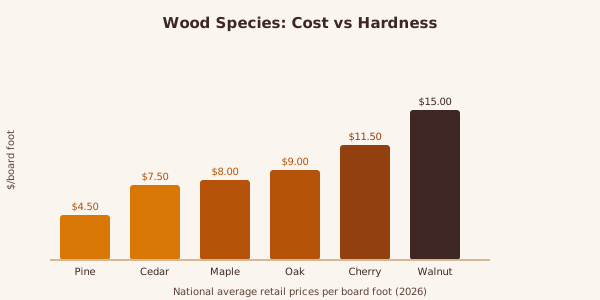
Cost at retail: roughly $4.50 per board foot for standard pine boards. Framing lumber (SPF, SYP, Hem-Fir) is typically priced by the linear foot or per piece; a 2×4×8 costs $5–8 depending on current market conditions.
Pine's limitation is durability in wet conditions. Untreated pine outdoors deteriorates quickly. For any ground contact or regular moisture exposure, either use pressure-treated pine or switch to cedar.
Oak: The Furniture Standard
Red oak is the most common hardwood at US lumber dealers. White oak is slightly more expensive and more popular for high-end flooring and outdoor applications because of its closed grain (tyloses seal the vessels, making it more water-resistant).
Oak's Janka hardness: red oak at 1290 lbf, white oak at 1360 lbf. Both are substantially harder than pine, which is why oak is the default for floors, furniture, and cabinetry. It holds screws well, glues reliably, and stains evenly because of its pronounced open grain.
The downside is cost ($9.00/board foot for red oak) and weight. Oak runs heavy (roughly 44 lbs per cubic foot), which matters for large furniture pieces and for shipping. Oak also moves with humidity, so furniture and flooring designed in oak needs to account for seasonal expansion.
For visible interior projects like dining tables, bookshelves, and cabinets, oak delivers the look and durability most people expect at a reasonable price point for a hardwood. For projects where you want dramatic grain, oak is often a better choice than maple.
Cedar: The Outdoor Champion
Western Red Cedar is the go-to for any exterior application where you want natural wood: decks, fences, pergolas, siding, garden boxes. Its natural oils resist rot and insect damage without chemical treatment, and it's dimensionally stable through moisture changes better than most species.
Cedar's Janka hardness is 350 lbf (softer than pine), but outdoor durability isn't about hardness, it's about rot resistance. Cedar outperforms untreated pine dramatically in ground proximity or weather exposure. A cedar fence typically lasts 15–20 years with basic maintenance; untreated pine fence would need replacement in 5–8 years.
Cost: about $7.50/board foot at retail, making it more expensive than pine but significantly cheaper than hardwoods. For deck projects, compare cedar's 15-year maintenance cost against composite decking; composites often win on long-term cost despite higher upfront price, but cedar wins on natural appearance and ease of repair.
Cedar is also lightweight (23 lbs per cubic foot) and easy to cut. It's forgiving of basic carpentry skills, which makes it popular for DIY outdoor projects.
Maple: For Hard Wear
Hard maple (sugar maple) has a Janka hardness of 1450 lbf, harder than red oak and much harder than pine. This makes it the standard for butcher blocks, workbench tops, bowling alleys, and flooring in high-traffic areas. It also machines to an exceptionally smooth surface, which is why maple is standard for kitchen cabinets and interior doors where a fine finish matters.
At $8.00/board foot, maple is similar in cost to red oak but tends to be tighter-grained and more uniform in appearance. It doesn't take stain as evenly as oak due to its fine, closed grain; blotching is a common problem. To get a consistent finish on maple, use a wood conditioner before staining, or stick to clear finishes that let the natural color show.
Soft maple (silver maple, red maple) is cheaper and softer (950 lbf Janka), and is sometimes sold under the name "maple" at lumber yards. Confirm which species you're buying if hardness matters for your application.
Walnut: When Appearance Is Everything
Black walnut is the premium domestic hardwood for fine furniture and decorative work. Its deep brown color with purple undertones needs no staining; the natural color is the finish. Walnut is used for statement pieces: dining tables, desks, gun stocks, decorative bowls.
At $15.00/board foot, walnut is the most expensive species in the calculator. It's harder than pine (1010 lbf Janka) but softer than oak or maple, which limits its use in high-traffic floor applications. For furniture and cabinetry, the hardness is more than adequate.
Walnut glues well and machines cleanly. Flat-sawn walnut shows dramatic figure; quartersawn walnut is more stable with a tighter, straighter grain. For a table where the grain is a design feature, flat-sawn is usually the choice.
Cherry: The Aging Classic
American black cherry is prized for its color evolution: it starts a light pinkish-tan and darkens to a deep reddish-brown over several years of light exposure. This aging process is unique among domestic hardwoods.
Hardness is 950 lbf (similar to soft maple), which is adequate for furniture but not floors in high-traffic areas. Cost at $11.50/board foot puts it between oak and walnut. Cherry machines very cleanly and is easy to finish, making it popular among amateur and professional furniture makers alike.
The main consideration with cherry is planning for color change. A new cherry piece will look noticeably different from the same piece two years later. This is a feature for most buyers, but it means cherry furniture in a room with inconsistent light exposure can develop uneven color.
Side-by-Side Summary
For framing, structural, and basic interior work: pine. For hardwood floors, furniture, and cabinets where stained appearance matters: oak. For outdoor projects: cedar. For butcher blocks, workbench tops, and maximum hardness: hard maple. For high-end furniture where color is the statement: walnut or cherry.
Most projects have a clear best answer. Run your material quantity through the free lumber calculator for whichever species you choose. The cost difference between pine and walnut on the same project can easily be 3–4× the raw material cost.
Bench · Try the calculator
Lumber Calculator
Professional lumber calculator for woodworkers, contractors, and DIY enthusiasts. Calculate board feet, linear feet, and project costs.
Open calculator →