How to Estimate Lumber for Any Project
Learn the step-by-step process for calculating lumber quantities accurately, with real examples for decks, framing walls, and furniture projects.
Start With a Materials List, Not a Guess
Every experienced builder will tell you the same thing: never walk into a lumber yard without a materials list. Estimating "roughly how much wood I need" leads to two trips back, or buying far too much. A proper lumber estimate takes 15–20 minutes and saves hours of wasted time.
The process is the same whether you're framing a wall, building a deck, or making furniture. You break the project into components, calculate the lumber needed for each component, add a waste factor, and total it up by size and species.
This guide walks through the exact process with working examples for three common project types.
Step 1: Break the Project Into Components
Before you calculate anything, draw out your project (even a rough sketch) and label every piece of lumber. Group them by size: all the 2×4s together, all the 2×6s together, and so on.
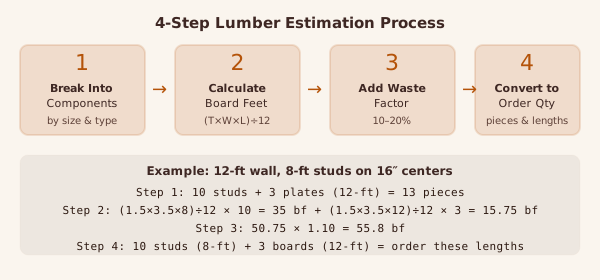
For a framed interior wall 12 feet long and 8 feet tall: you have a bottom plate (1 board at 12 feet), a top plate (1 board at 12 feet; some codes require double top plates, so possibly 2), and studs on 16-inch centers. Studs at 16-inch spacing in a 12-foot wall: 12 feet = 144 inches ÷ 16 inches = 9 spaces, so 10 studs.
Component list: 2–3 boards at 12 feet (plates), 10 boards at 8 feet (studs). All 2×4. That is your starting quantity before waste.
Step 2: Calculate Board Feet per Component
Once you have quantities and sizes, calculate board footage for each component. The formula: Board Feet = (Thickness × Width × Length) ÷ 12.
For the wall example using actual dimensions:
Plates: 2 boards × (1.5 × 3.5 × 12) ÷ 12 = 2 × 5.25 = 10.5 board feet
Studs: 10 boards × (1.5 × 3.5 × 8) ÷ 12 = 10 × 3.5 = 35 board feet
Total: 45.5 board feet of 2×4
Or enter this directly into the lumber calculator: set size to 2×4, length to 12, quantity to 2 for the plates. Then run it again with length 8, quantity 10 for the studs. Add the totals.
Step 3: Add Waste
Raw lumber quantities are never your order quantity. Real projects involve cuts, defects, warped boards, and mistakes. Standard waste factors:
For the wall framing example at 10% waste: 45.5 board feet × 1.10 = 50 board feet. Round up to the nearest standard board length. Since you're buying 8-foot and 12-foot boards anyway, rounding up already handles most of the buffer.
For hardwood projects, 20% is conservative but appropriate. You'll reject boards with knots, checks, or sapwood, and you'll have more offcuts from fitting pieces.
Step 4: Convert to Order Quantities
Lumber yards sell by the piece, not by the board foot. Convert your board-foot estimate to actual boards you'll order.
If you need 50 board feet of 2×4, and each 8-foot 2×4 contains 3.5 board feet (using actual dimensions), you need 50 ÷ 3.5 = 14.3 boards. Order 15, or consider buying some 10-foot or 12-foot boards for the plates so you don't have spliced joints.
For hardwood orders, tell the dealer your board-foot total and let them select boards. They know their inventory and can pull boards that minimize waste for your project dimensions. Say "I need 40 board feet of 4/4 white oak, surfaced two sides, mostly 6–8 inch wide boards" and they'll sort it for you.
Deck Estimation Example
A 16×20 foot deck with 2×6 decking boards running the 20-foot direction, on 12-inch centers.
First, calculate how many boards: 16-foot dimension ÷ 12-inch spacing = 16 boards. Add one for the last edge = 17 boards. Each board runs 20 feet.
Board feet: 17 boards × (1.5 × 5.5 × 20) ÷ 12 = 17 × 13.75 = 233.75 board feet. Add 15% waste for outdoor work (knots, defects, weathered ends): 233.75 × 1.15 = 269 board feet.
For cedar at $7.50/board foot, that's roughly $2,020 in decking lumber. Run the deck lumber estimate in the board feet calculator: select 2×6, set length to 20, quantity to 17, species to cedar, and you'll get cost, weight, and board footage in one shot.
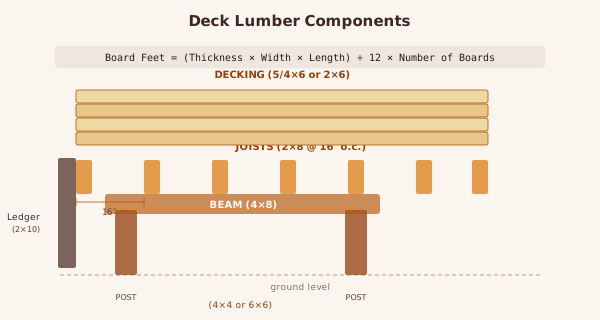
Don't forget the framing: joists, rim joists, posts, and beams are separate calculations. Add them individually.
Furniture Estimation Example
A simple bookcase: 4 shelves at 36 inches wide and 12 inches deep, two sides at 36 inches tall, a back panel (plywood, not covered here), a top piece.
Using 1×12 boards (actual 0.75″ × 11.25″):
4 shelves at 3 linear feet each: 4 × (0.75 × 11.25 × 3) ÷ 12 = 4 × 2.11 = 8.44 board feet
2 sides at 3 linear feet each: 2 × (0.75 × 11.25 × 3) ÷ 12 = 2 × 2.11 = 4.22 board feet
Top at 3 linear feet: 1 × 2.11 = 2.11 board feet
Total: 14.77 board feet of 1×12
For 1×12 pine at $4.50/board foot, rough material cost runs about $66. Add 15% waste: 17 board feet, about $76. That's your raw lumber budget before hardware and finish.
Common Estimation Mistakes
Forgetting the waste factor tops the list. Second: calculating in one species then ordering another. Pine framing lumber and pine finish lumber are priced differently; make sure your estimate matches what you actually order.
Third mistake: ordering all one length when mixed lengths would be more efficient. A 16-foot run of decking is often better served by 16-foot boards than two 8-footers with a splice joint. Check what lengths your supplier stocks before finalizing your cut list.
Fourth: not accounting for rough vs surfaced hardwood. If you need 20 board feet of 4/4 oak finished width at 6 inches, order 22–23 board feet to allow for the surfacing material loss and selection.
The free lumber estimator handles the board-foot math instantly. Use it to run each component separately, then add the results for your total project estimate.
Bench · Try the calculator
Lumber Calculator
Professional lumber calculator for woodworkers, contractors, and DIY enthusiasts. Calculate board feet, linear feet, and project costs.
Open calculator →