Nominal vs Actual Lumber Dimensions: Full Guide
A 2×4 is not 2 inches by 4 inches. Learn why nominal and actual lumber sizes differ, and get the exact measurements for every common size.
Why Your 2×4 Isn't 2×4
Walk into any lumber yard, grab a 2×4, and measure it. You'll get 1.5 inches by 3.5 inches. Not 2×4. This isn't a scam; it's the result of how lumber is milled, dried, and surfaced. Understanding the difference between nominal and actual dimensions saves you from measurement errors that waste wood and money.
The short version: nominal size is the name. Actual size is what you measure. They diverged during the 20th century as the industry standardized on surfaced (planed) lumber rather than rough-sawn boards. Today, when you buy any standard dimensional lumber, you're buying surfaced lumber where a significant fraction of the original rough size has been removed.
How the Size Gap Happens
When a log gets cut at a sawmill, the blade cuts it to rough (nominal) dimensions, a true 2×4. That green, unseasoned board then goes into a kiln for drying. As moisture leaves the wood, the board shrinks. After drying, a planer removes the rough saw surface on all four sides, knocking off another fraction of an inch per face.
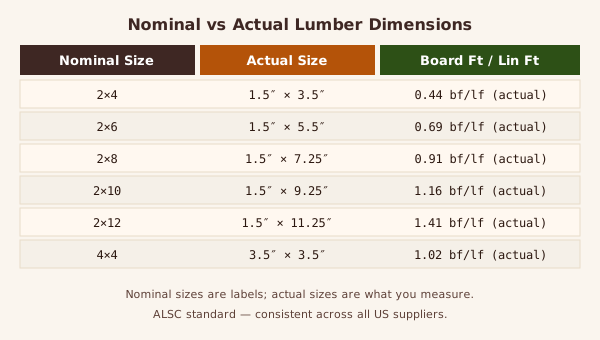
The final result: what started as a 2×4 rough board ends up as a 1.5×3.5 finished board. The American Lumber Standard Committee (ALSC) codifies these finished sizes as the standard, so every supplier across the country sells lumber with the same actual dimensions.
This standardization is a good thing. It means a 2×4 from a Home Depot in Texas and a 2×4 from a lumber yard in Maine have the same actual dimensions. Your building plans work everywhere.
Standard Nominal vs Actual Dimensions
Here are the actual dimensions for every common softwood framing size:
The pattern is consistent: 1x lumber is 0.75″ thick (down from nominal 1″); 2x lumber is 1.5″ thick (down from nominal 2″); 4x lumber is 3.5″ thick (down from nominal 4″). Width losses follow the same pattern: nominal widths of 2–7 inches lose 0.5 inch; widths of 8 inches and wider lose 0.75 inch.
Hardwood Sizing Is Different
Hardwood lumber doesn't follow ALSC softwood standards. The National Hardwood Lumber Association (NHLA) governs hardwood sizing, and they use a quarter-inch system for thickness.
Hardwood thickness is listed in quarters: 4/4 (pronounced "four-quarter") means one inch nominal rough thickness. 6/4 is 1.5 inches rough. 8/4 is two inches rough. After surfacing two sides (S2S), each face loses about 1/16″ to 1/8″, so 4/4 stock finishes to roughly 13/16″ or 7/8″, depending on the supplier and species.
Width and length for hardwoods are random: boards aren't ripped to standard widths. You buy whatever the tree gave you. This is why hardwood dealers sell by the board foot: it accounts for the variation in width that fixed-size softwood pricing can't capture.
Why This Matters for Your Projects
Structural calculations: if your engineer specifies a 2×10 floor joist, their span tables and load calculations are based on actual dimensions (1.5″ × 9.25″), not nominal. Don't substitute a different-sized board thinking the names match; actual dimensions drive structural performance.
Joinery and fitting: if you're building a bookcase and plan a shelf that's exactly 11.25 inches wide, buy a 1×12 (actual 0.75″ × 11.25″). But don't plan for an 11.5-inch shelf thinking a 1×12 covers it. The gap matters when fitting between two walls or aligning with other millwork.
Calculating board feet: our lumber calculator lets you toggle between nominal and actual dimensions for exactly this reason. If your plans list board footage by nominal size, use nominal mode. If you're calculating actual material volume for weight or structural purposes, switch to actual dimensions. The difference between nominal and actual board footage on a large order can add up to 20–25%.
Practical Tips for Using This Information
When you read a building plan, check whether it specifies nominal or actual dimensions. Modern structural plans almost always use actual dimensions for member sizing. Finish carpentry and trim plans often use nominal names without specifying.
When you order lumber, confirm with your supplier that you understand which dimension they're using to price. Most softwood lumber yards price per linear foot or per piece for standard sizes, so the nominal/actual issue rarely affects the price. But if you're ordering from a hardwood dealer who quotes per board foot, you need to know whether that board-foot price is based on rough (nominal) or surfaced (actual) thickness.
For deck and exterior framing projects, also account for the fact that pressure-treated lumber can be dimensionally inconsistent due to moisture added during treatment. A pressure-treated 2×6 may actually measure closer to 1.5″ × 5.75″ when wet, and will shrink toward nominal actual size (1.5″ × 5.5″) after drying on site.
Board Feet Calculation With Actual Dimensions
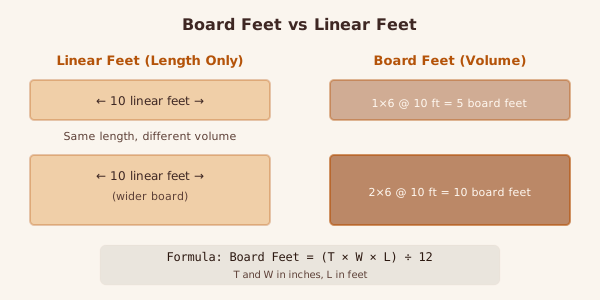
Once you know actual dimensions, you can calculate accurate board footage. The formula: Board Feet = (Actual Thickness in inches × Actual Width in inches × Length in feet) ÷ 12.
A 2×10 at 12 feet, using actual dimensions: (1.5 × 9.25 × 12) ÷ 12 = 13.875 board feet per piece. Using nominal: (2 × 10 × 12) ÷ 12 = 20 board feet. That is a 44% difference, significant when pricing large hardwood orders.
Try entering a 2×10 into the board feet calculator and toggle between nominal and actual modes to see this difference visually.
The Bottom Line
A 2×4 is 1.5″ × 3.5″. A 2×6 is 1.5″ × 5.5″. Every common framing size follows the same pattern, and knowing actual dimensions prevents planning errors that cost you material and time. For hardwoods, learn the quarter system (4/4, 6/4, 8/4) and always confirm whether a quote is based on rough or surfaced stock. When in doubt, measure before you cut.
Bench · Try the calculator
Lumber Calculator
Professional lumber calculator for woodworkers, contractors, and DIY enthusiasts. Calculate board feet, linear feet, and project costs.
Open calculator →