How to Store Lumber to Prevent Warping and Waste
Improper lumber storage causes warping, cupping, and mold. Learn the right way to stack and store wood for any length of time.
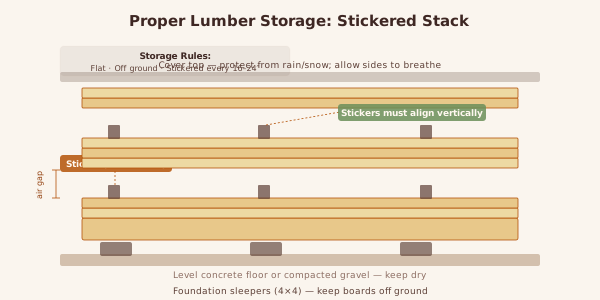
Stored Wrong, Lumber Becomes Scrap
You can buy perfect, straight boards and turn them into warped, cupped garbage in two weeks by storing them incorrectly. Wood moves with moisture. Every board in your stack is constantly responding to the humidity in its environment. Proper storage controls that movement so the wood you bought is still the wood you need when you're ready to use it.
The principles are simple: support the boards flat and level, allow air to circulate around every piece, keep moisture from reaching the wood, and store near your intended use environment whenever possible.
The Stickering Principle
The most important practice in lumber storage is stickering, which means placing thin strips of wood (stickers) perpendicular to your boards, across the width of the stack, at regular intervals. Stickers elevate each layer of boards off the layer below, allowing air to circulate around all four faces.
Without stickers, the faces of adjacent boards are in direct contact. The surfaces can't breathe, moisture gradient develops between the faces, and the board cups or warps to equalize. A single week in direct contact with another board can permanently bow a straight piece of hardwood.
Sticker spacing: for 4/4 hardwood, place stickers every 16–24 inches along the length. For thick slabs or heavy lumber (8/4 and above), you can stretch to 24–30 inches. The weight of heavy lumber helps keep it flat; thin boards need more support to prevent sagging between stickers.
Sticker alignment: stack your stickers directly over each other, layer by layer. A crooked stack transfers stress into the boards. Consistent vertical alignment means the weight path is straight and the boards stay flat.
Sticker thickness: 3/4 inch to 1 inch is standard. Thicker stickers allow more airflow; thinner stickers work but allow the board faces to get closer. Never use stickers that are thinner on one end than the other; tapered stickers introduce stress.
Foundation and Leveling
Your sticker stack needs a flat, level base. A concrete or gravel floor that's not level enough will allow the entire stack to tilt, introducing twist into every board above it.
For shop storage, a flat concrete floor with 4-inch-thick dimensional lumber as your base layer works well. Place your base pieces on 12-inch centers, shimmed to level. Check with a 4-foot level across the base before stacking.
For outdoor storage, elevate the entire stack at least 6–8 inches off the ground on cinder blocks or treated lumber. Ground moisture wicks into stacked wood through capillary action. Even on pavement, standing water after rain can raise the moisture content of the bottom boards significantly.
Moisture and Environment
Lumber acclimatizes to its environment. A board milled in a humid climate and moved to a dry climate will shrink. A board purchased at a home center (often stored in a relatively uncontrolled environment) moved to a heated, dry workshop will lose moisture and shrink in width.
For furniture and fine woodworking, this acclimatization matters. Wood moved directly from a cold, wet lumber yard into a heated shop and immediately machined will change dimensions after machining. The standard recommendation is to let hardwood acclimatize in your shop for 1–2 weeks before final dimensioning. For very wide or thick slabs, 3–4 weeks is better.
Target moisture content depends on final use: interior furniture in a climate-controlled environment should acclimate to 6–8% moisture content (MC). Exterior wood can stay at 12–15% MC since it will see more moisture variation in service.
A cheap moisture meter ($20–40) is worth having if you work with hardwood regularly. Check your boards on arrival and again before machining. If the MC is more than 2% from your target, give them more time.
Covering and Protecting the Ends
Board ends are the most vulnerable part of a stored piece. End grain is open across the growth rings, and moisture moves in and out of end grain roughly 10× faster than through face grain. This means the ends of a board can dry out significantly faster than the middle, causing end-checking (small cracks radiating from the end grain).
Commercial sawmills seal board ends with wax emulsions immediately after cutting. For shop storage, you can apply paste wax, latex paint, or commercial end-grain sealer to board ends. This slows the moisture differential between ends and center, reducing checking.
For framing lumber stored outdoors: a tarp or metal roof cover over the top of the stack protects from rain while still allowing side ventilation. Don't wrap the whole stack in plastic; that traps moisture and promotes mold and mildew. Cover the top, let the sides breathe.
For hardwood slabs stored long-term: keep them in a covered but ventilated space. A barn, garage, or shed is fine. Fully enclosed climate-controlled storage is better but rarely necessary unless you're holding very valuable figured material for extended periods.
Storage Duration and Expectations
Short-term storage (2–8 weeks): as long as your stack is stickered and dry, most lumber will come through a few weeks in good shape. Framing lumber destined for the job site next month doesn't need elaborate care.
Medium-term storage (2–6 months): acclimatization in your shop environment is essential for hardwoods. Framing lumber can handle this duration outdoors under a tarp with reasonable stickering. Check the stack monthly for any boards that have shifted or are showing unusual movement.
Long-term storage (6 months to several years): hardwood slabs and planks for furniture are often stored for a year or more while they continue to dry and acclimate. Annual inspection to re-sticker any sagging boards and check for insect activity is important. Some species (walnut, cherry, oak) will continue to dry past initial equilibrium for 1–2 years after milling, which is fine and normal.
Practical Storage Solutions
Shop storage: build a simple lumber rack from 2×4 wall-mounted brackets with horizontal arms extending 24 inches from the wall. Cantilever arms at 24-inch vertical spacing hold most dimensional sizes. Keep species separated and labeled; boards look very similar when stacked.
Garage storage: overhead ceiling storage using 2×6 ledgers screwed to ceiling joists works well for long boards. Keep weight reasonable (ceiling joists have limited capacity for storage loads) and don't store anything above a car you care about.
Outdoor covered storage: a simple 4×8 or 8×16 lean-to structure with a metal roof handles rough lumber and framing material well. Keep the stack 12 inches from walls to allow airflow, and elevate the base 8 inches off the ground.
For any storage situation, the lumber calculator's weight estimate helps you plan the structure. Walnut at 3.8 lbs per board foot and pine at 2.5 lbs per board foot add up quickly. A 200-board-foot stack of walnut weighs roughly 760 lbs, so plan your storage structure accordingly.
Bench · Try the calculator
Lumber Calculator
Professional lumber calculator for woodworkers, contractors, and DIY enthusiasts. Calculate board feet, linear feet, and project costs.
Open calculator →