How Much Does Lumber Cost in 2026?
Current lumber prices by species and size, plus the factors that make costs swing 20–40% between suppliers. Updated for 2026.
Lumber Prices in 2026
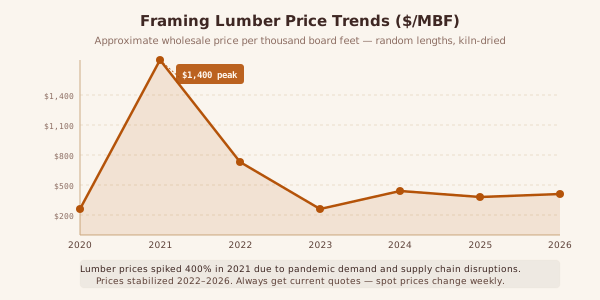
After the dramatic swings of 2020–2022 (when framing lumber briefly hit $1,500 per thousand board feet), the market has stabilized significantly. In 2026, retail framing lumber prices sit in a range that's roughly double pre-pandemic levels but well below the pandemic peaks.
Here's what you can expect to pay at a typical home center or lumber yard for common species at retail quantities (one to fifty pieces):
Current Retail Prices by Species
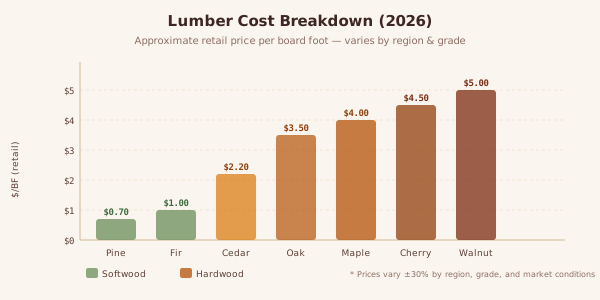
Softwood framing lumber (2×4 SPF, SYP, or Hem-Fir): $5–8 per piece for an 8-foot board, translating to roughly $3.50–5.00 per board foot at retail. At wholesale for large framing orders, contractors often pay $350–450 per thousand board feet.
Pine finish boards (1×6, 1×8, 1×12): $4.00–5.00 per board foot at home centers. Clear pine with no knots commands a premium; clear 1×6 pine runs $5.50–7.00 per board foot. Knotty pine is cheaper at $3.00–4.50 per board foot.
Red oak: $8–10 per board foot at hardwood dealers. Home centers sometimes stock 1×4 and 1×6 red oak for trim at $9–12 per board foot depending on grade and region.
Hard maple: $7.50–10.00 per board foot, depending on grade and figure. Curly or tiger maple commands significant premiums: 50–100% over straight-grain prices.
Black walnut: $12–18 per board foot for standard figured boards. Wide, clear, figured walnut for tabletops can run $20–30+ per board foot at specialty dealers.
American cherry: $10–14 per board foot, similar to walnut in range but with more variation by grade and width.
Cedar (Western Red): $6–9 per board foot for deck-grade boards. Clear cedar with no knots runs toward the high end; knotty cedar is on the lower end.
Pressure-treated pine (above-ground rating): $4.50–7.00 per board foot depending on size. Larger structural sizes (6×6, 4×8) have lower per-board-foot prices than smaller sizes.
What Drives the Difference Between Suppliers
The same 2×4 can cost 15–30% more at a home center than at a local lumber yard. Here's why:
Big-box home centers price for convenience. They carry a limited selection of standard sizes, buy in massive quantities, and pass some of that volume discount along, but they also build in healthy margins on lumber since it's a traffic driver, not a loss leader. For 1–20 boards, home centers are often competitive. For 200 boards, a lumber yard beats them on price.
Local lumber yards have better pricing on large orders and carry a wider range of species and grades. They also stock longer lengths (16-foot, 18-foot, 20-foot boards are rare at home centers but standard at a yard). The trade-off: you may need a minimum order, and selection varies by region.
Hardwood dealers are the right source for anything oak, maple, walnut, cherry, or unusual domestic species. Their pricing is competitive with any online source once you factor in shipping, and they can select boards to match your specific project needs.
Online lumber dealers (such as Bell Forest Products, Woodworkers Source, or Hearne Hardwoods) are worth comparing for specialty hardwoods. Shipping costs matter; a 50-board-foot order of walnut shipped across the country might cost $100–200 in freight, which can offset any price advantage.
Price Variation by Grade
Lumber grade is the biggest within-species price driver. For framing lumber:
For hardwoods, the NHLA grading system runs from FAS (Firsts and Seconds, meaning the best, widest, clearest boards) down through Select, #1 Common, #2 Common, and below. FAS walnut might run $18/board foot; #1 Common walnut might run $13/board foot. For furniture where you're matching grain and minimizing waste, FAS is worth the premium. For painted cabinetry where grain doesn't show, #2 Common is fine.
Regional Price Differences
Lumber prices vary by region based on proximity to mills, transportation costs, and local demand. Pacific Northwest states pay less for Douglas Fir and Western Red Cedar because mills are close. Southeast states pay less for Southern Yellow Pine. The Midwest and Northeast pay more for both due to shipping distance.
Typical regional premium for framing lumber: 10–20% above Pacific Northwest pricing for similar grades. For hardwoods, the premium is smaller because hardwood species are distributed across the country.
How Seasonal Pricing Works
Spring is the most expensive time to buy lumber. Construction activity picks up as weather improves, and demand spikes. Prices at the retail level can run 10–15% higher in March–June compared to October–January.
If your project allows any flexibility on timing, buying lumber in fall or early winter typically gets you better pricing and better selection; yards aren't as picked over as they are in peak season.
Estimating Your Project Cost
Use the lumber cost calculator to get a ballpark before you start calling suppliers. Enter your lumber size, length, quantity, and species, and it shows estimated cost based on current national average retail prices. These serve as planning figures; your actual quote from a supplier will reflect your local market and order size.
For any project over $1,000 in lumber, get at least two quotes. For hardwood projects over $500 in material, always visit the dealer and select your boards in person, especially for figured species where appearance drives the decision.
The calculator also shows weight, which matters for delivery planning. A full framing package for a 1,500 square foot house can weigh 15,000–25,000 lbs; plan for a delivery truck with a boom or forklift if you can't stage material close to your work area.
Bench · Try the calculator
Lumber Calculator
Professional lumber calculator for woodworkers, contractors, and DIY enthusiasts. Calculate board feet, linear feet, and project costs.
Open calculator →