Hardwood vs Softwood: Which Should You Use?
Hardwood and softwood differ by tree type, not actual hardness. Learn which category fits your project for framing, flooring, furniture, and outdoor work.
The Terms Are Botanical, Not Physical
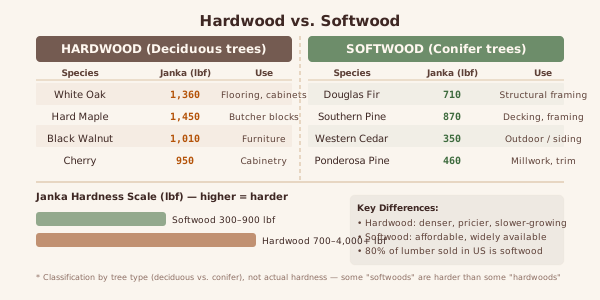
Here's the confusing part: balsa wood is technically a hardwood, and it's one of the softest materials you can buy. Yew is a softwood, and it's harder than many hardwoods. The classification has nothing to do with how hard the wood actually is.
Hardwoods come from deciduous trees (those that lose their leaves each year). Softwoods come from coniferous trees, the evergreens with needles. That botanical distinction determines how the wood is grown, milled, priced, and typically used, even though actual hardness overlaps between the categories.
Understanding the difference helps you make better purchasing decisions and avoid the most common mistake: using the wrong category for the application.
Hardwood Characteristics
Most hardwood species have a more complex cellular structure than softwoods. They grow more slowly (typically decades to maturity vs years for softwoods), which produces denser, tighter grain. The slower growth makes hardwood supply more limited and prices higher.
Common domestic hardwoods: red oak, white oak, hard maple, black walnut, American cherry, black ash, poplar. Common imported hardwoods: mahogany, teak, ipe, teak, bubinga, wenge.
Hardwood Janka hardness ranges widely. Balsa: 22 lbf. Poplar: 540 lbf. Cherry: 950 lbf. Red oak: 1290 lbf. Hard maple: 1450 lbf. Brazilian walnut (ipe): 3680 lbf. The range is enormous.
Hardwoods are priced and sold by the board foot, in random widths and lengths. They're graded by the NHLA system (FAS down to #2 Common). Most are sold in 4/4, 5/4, 6/4, 8/4, and thicker slabs for furniture, flooring, and millwork.
Softwood Characteristics
Softwoods grow faster and are harvested more frequently, making them cheaper and more consistently available. The faster growth produces wider growth rings and a less dense structure in most species, though not always (longleaf pine, for instance, is denser than many hardwoods).
Common domestic softwoods: Eastern White Pine, Western White Pine, Southern Yellow Pine, Douglas Fir, Sitka Spruce, Western Red Cedar, Port Orford Cedar, Engelmann Spruce, Ponderosa Pine.
Softwoods are sold as dimensional lumber in standardized sizes (2×4, 2×6, 2×8, etc.) and graded by the ALSC system (#1, #2, Select Structural, etc.). They're the default for structural framing, decking, siding, and most construction applications.
Where Each Category Excels
Structural framing: softwood, always. The combination of standardized sizing, consistent availability, reasonable strength (especially Southern Yellow Pine and Douglas Fir), and cost makes softwood framing lumber the industry default. Using hardwoods for structural framing would cost 3–8× more with minimal structural benefit.
Hardwood flooring: hardwood, usually. The harder species (oak, maple, hickory) hold up to foot traffic better. However, some softwood species are used for flooring in historic restorations and specific aesthetic applications; wide-plank pine floors are common in older New England architecture.
Furniture and cabinetry: either, depending on the application. For painted furniture, poplar (hardwood) and pine (softwood) are common choices because paint hides the grain, so species appearance does not matter and cost is the primary driver. For stained or natural finish furniture, the species choice becomes an aesthetic decision. Walnut, cherry, and oak are hardwood favorites. Pine is used for country/cottage style pieces where the knots are part of the look.
Outdoor projects: softwood almost always. Western Red Cedar and pressure-treated pine dominate outdoor construction. Teak and ipe are hardwood exceptions used for premium outdoor furniture and decking, with ipe being one of the most durable outdoor woods available. But ipe runs $5–10 per board foot more than cedar and requires special fasteners.
Trim and molding: both categories work. Most painted trim is pine (cheap, machines cleanly). Stained trim is often oak. Pre-primed MDF trim (not wood at all) has taken significant market share from solid wood trim.
Hardwood Grading vs Softwood Grading
The grading systems are completely different, which trips up people who switch between the two.
Softwood grading (ALSC) evaluates strength: knot size, knot location, grain slope, wane, and splits. Grade stamps appear on every piece. For structural use, the grade tells you what allowable stresses the board can carry.
Hardwood grading (NHLA) evaluates clear face yield: how much clear (defect-free) material can be cut from the board. FAS grade means at least 83.3% clear yield on the poorer face. #1 Common means at least 66.7% clear yield. For furniture, a higher grade means fewer unusable sections and less waste, which offsets the higher per-board-foot price.
If you're buying hardwood for a project, understand the NHLA grades before you order. For furniture where appearance matters, FAS or Select is usually worth the premium. For painted cabinetry or blocked work (interior structural components of cabinets), #1 Common is perfectly adequate.
Cost Comparison
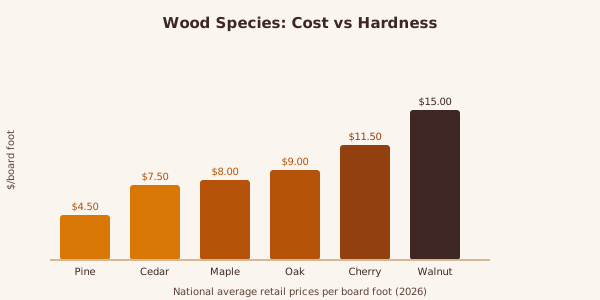
Framing softwood (SPF #2 2×4): roughly $3.50–5.00 per board foot at retail.
Pine finish boards (1×6, 1×8): $4.00–6.00 per board foot.
Red oak (FAS): $9–12 per board foot.
Hard maple (FAS): $8–11 per board foot.
Black walnut (FAS): $13–20 per board foot.
Ipe (tropical hardwood): $15–25 per board foot.
For a dining table requiring 40 board feet of material, the cost difference between pine ($180) and walnut ($640) is $460 in raw material. Whether that's worth it depends on whether the project justifies the premium, not on the wood category.
Use the lumber calculator to compare costs between species for your specific project quantities. The cost difference is most dramatic for large orders, which is exactly when you want to know the numbers before you start shopping.
Making the Decision
The project application almost always tells you which category to use. Structural framing → softwood. Outdoor exposure without treatment → cedar or PT pine (softwood). Hardwood floors in high-traffic areas → oak or maple (hardwood). Fine furniture with visible grain → hardwood of your choice. Painted furniture → poplar or pine (whichever is cheaper locally). Interior trim → pine for painted, oak for stained.
When the application doesn't specify, consider cost, appearance, workability, and durability in that order. Most woodworking decisions are straightforward once those four factors are ranked for the specific project.
Bench · Try the calculator
Lumber Calculator
Professional lumber calculator for woodworkers, contractors, and DIY enthusiasts. Calculate board feet, linear feet, and project costs.
Open calculator →