Framing Lumber 101: Sizes, Grades, and What to Buy
Everything you need to know about structural framing lumber: species, grades, sizes, span limits, and how to order for a wall, floor, or roof.
Framing Lumber Is Simpler Than It Looks
Walk into the framing lumber section of any home center and you'll see a few dozen SKUs. But structural framing actually comes down to 4–5 species in 2–3 grades in a handful of sizes. Once you understand those dimensions, you can confidently specify and order framing lumber for any residential project.
This guide covers what you need to know: species and grades, which sizes go where, how to read span tables, and how to calculate the quantities you need before you order.
Framing Lumber Species
Most framing lumber sold in the US falls into three species groups:
At the lumber yard, boards are often sold as "framing lumber" without explicit species labeling for standard 2× sizes. For critical structural applications (long-span floor joists, headers over large openings, ridge beams), know what species you're buying and verify it's adequate for your span table lookups.
Grades That Matter
Framing lumber is graded visually or mechanically for strength. The key grades in ascending order of strength:
For most residential framing, #2 grade is correct. For headers over doors and windows wider than 4 feet, or for floor joists spanning more than 14–15 feet, step up to #1 or confirm the span tables work with #2.
Which Size Goes Where
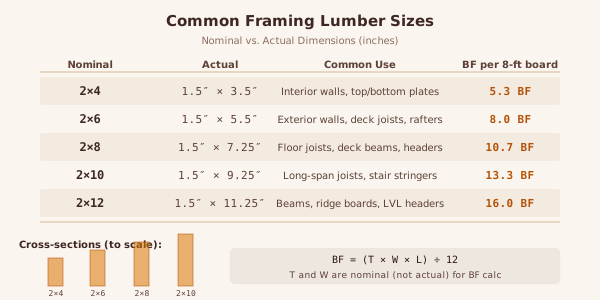
Wall framing uses 2×4 and 2×6 studs. 2×4 is standard for non-load-bearing partitions and exterior walls where insulation depth isn't a concern. 2×6 exterior walls are increasingly common because they allow 2-inch more insulation (R-19 vs R-13 batts), improving energy performance.
Floor joists typically run 2×8, 2×10, or 2×12 depending on span. As a rough guide for #2 SPF on 16-inch centers: 2×8 can span about 11–13 feet; 2×10 can span about 14–16 feet; 2×12 can span about 16–18 feet. These numbers vary significantly by species, grade, and load; always verify with the span tables in your local building code or a structural span calculator.
Ceiling joists follow similar sizing logic to floor joists but with lower loads (no live load from people or furniture).
Rafters use 2×6, 2×8, or 2×10 depending on slope, span, and snow load. Steeper slopes allow longer spans; higher snow loads require larger members or tighter spacing.
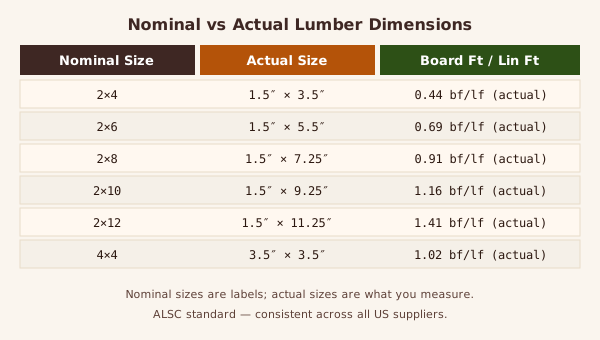
Headers over openings use doubled or tripled 2× lumber on edge (acting as a beam), or engineered lumber (LVL, PSL) for larger spans. A header over a 4-foot window in a bearing wall might be a doubled 2×8; a 16-foot garage door opening needs an engineered beam.
Calculating Framing Quantities
Wall studs: calculate your linear feet of wall, convert to inches, divide by stud spacing, add 1. A 24-foot wall on 16-inch centers: 24 feet = 288 inches ÷ 16 = 18 spaces + 1 = 19 studs. Add extra for corners, intersections, and window/door framing. A rule of thumb for exterior walls: 1 stud per linear foot of wall is a decent rough estimate including waste and extras.
Plates: each wall needs a bottom plate and typically a double top plate (2 top plates). Three plates per wall. A 24-foot wall needs three 24-foot runs = 72 linear feet of plate material. Order in 12-foot or 16-foot boards to minimize joints.
Joists: calculate the span direction length (not the span itself), divide by spacing, add 1. A 24-foot-wide house with joists on 12-inch centers spanning the width: 24 ÷ 1 = 24 + 1 = 25 joists, each at whatever your span length is (say, 14 feet for a 12+2-foot cantilever each side). Add rim joists and doubled joists under bearing walls.
For a quick board-foot estimate of your framing package, use the lumber calculator: enter each size and quantity separately, sum the totals. For a 1,000 square foot house footprint with 8-foot walls, expect roughly 5,000–7,000 board feet of framing lumber depending on the plan complexity.
Pressure-Treated Framing
Any framing in contact with concrete, masonry, or within 6 inches of grade must be pressure-treated (PT) lumber per most building codes. This includes: bottom plates on concrete slabs, posts in ground contact, ledger boards, and any structural member in a crawl space with inadequate air circulation.
PT lumber comes in above-ground ratings (UC2, UC3B) and ground-contact ratings (UC4A, UC4B). Specify the right treatment for your application; above-ground PT used in ground contact will eventually rot.
PT lumber is heavier, harder to cut (dull blades faster), and needs galvanized or stainless steel fasteners (not standard bright nails, which corrode in contact with the treatment chemicals). Also note that freshly treated lumber often has excess moisture; allow it to dry on site before installing finish materials over it.
Ordering Tips
Order lengths that match your plan dimensions with minimal waste. For 8-foot-ceiling walls with 2×4 or 2×6 studs, buy 8-foot boards with no cut waste. For plates in a 24-foot wall, 12-foot boards minimize joints. Don't order all 8-foot material if your plan has 10-foot or 12-foot spans; you'll pay for waste cuts.
Add 10% to framing lumber quantities for standard waste. For complex plans with many openings, use 15%. Check that your order specifies the correct species and grade; "framing lumber" without specification might get you what the yard has most of, which may not match your span table assumptions.
Bench · Try the calculator
Lumber Calculator
Professional lumber calculator for woodworkers, contractors, and DIY enthusiasts. Calculate board feet, linear feet, and project costs.
Open calculator →