How Much Lumber Do You Need for a Deck?
Calculate deck lumber quantities for decking boards, joists, beams, and posts. Includes a worked example for a 12×16 deck with cost breakdown.
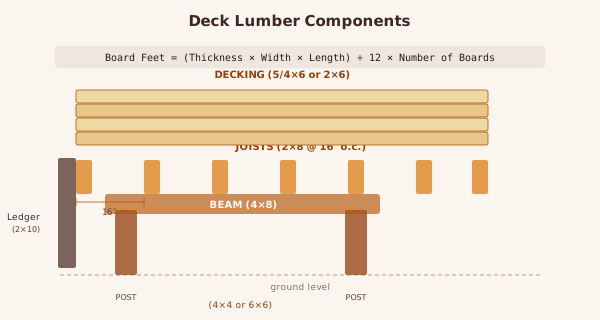
Deck Lumber Has Five Components: Calculate Each Separately
Most people think about deck lumber as just the boards you walk on. But a complete deck estimate includes five distinct lumber types: decking boards, joists, beams, posts, and rim boards. Each uses a different size and species. Lumping them together produces a useless estimate.
This guide walks through a complete material takeoff for a 12×16 foot freestanding deck, 3 feet off the ground, using cedar decking and pressure-treated framing. Run each component through the lumber calculator and you'll have a complete materials list before you buy a single board.
Component 1: Decking Boards (2×6 Cedar)
Deck boards are what you see and walk on. They run perpendicular to the joists. Standard spacing: boards are typically spaced 1/8″ apart to allow drainage and expansion.
For a 12×16 deck with boards running the 12-foot direction across the 16-foot dimension:
Number of boards needed: 16 feet ÷ (5.5 inches actual width + 0.125 inch gap) = 16 ÷ 0.479 = 33.4, so 34 boards. Add one for the edge = 35 boards. Each board is 12 feet long.
Board feet: 35 boards × (1.5 × 5.5 × 12) ÷ 12 = 35 × 8.25 = 288.75 board feet.
With cedar at $7.50/board foot and a 15% waste factor: 288.75 × 1.15 = 332 board feet = $2,490.
Component 2: Joists (2×8 Pressure-Treated)
Joists support the decking boards. They run parallel to the 12-foot dimension, spanning between the beam and the ledger or rim joists.
For a 16-foot span in the 12-foot direction with 16-inch on-center spacing: 12 feet ÷ 1.33 = 9 spaces + 1 = 10 joists. Add 2 rim joists at 16 feet each.
Joist length: 12 feet (or cut to span). Rim joists: 16 feet.
Board feet for joists: 10 × (1.5 × 7.25 × 12) ÷ 12 = 10 × 9.0625 = 90.6 board feet.
Rim joists: 2 × (1.5 × 7.25 × 16) ÷ 12 = 2 × 14.5 = 29 board feet.
Total joist lumber: 119.6 board feet. At $4.50/board foot for pressure-treated pine: $538.
Note: pressure-treated lumber prices vary significantly by treatment level and region. These are representative retail figures.
Component 3: Beam (4×8 Pressure-Treated)
A 12×16 freestanding deck typically needs one main beam running the 16-foot width, supported by posts. For a deck this size, one or two 4×8 beams (sometimes doubled 2×8s) work well.
For one 16-foot 4×8 beam: (3.5 × 7.25 × 16) ÷ 12 = 33.8 board feet. At $4.50/board foot for PT: $152.
Many builders use doubled 2×8s instead of a single 4×8 because they're easier to handle and readily available. Doubled 2×8 at 16 feet: 2 × (1.5 × 7.25 × 16) ÷ 12 = 2 × 14.5 = 29 board feet, slightly less lumber volume than a solid 4×8.
Component 4: Posts (4×4 or 6×6 Pressure-Treated)
Post height depends on deck height. For a deck 3 feet off the ground with 18 inches below grade for footings: posts are roughly 4.5 feet long. Three posts (one at each corner plus one mid-span) is typical for this size.
Board feet per 4×4 post at 5 feet: (3.5 × 3.5 × 5) ÷ 12 = 5.1 board feet. Three posts: 15.3 board feet = about $69.
For decks more than 4 feet above grade, 6×6 posts are standard in most jurisdictions. At $4.50/board foot for 6×6 pressure-treated: (5.5 × 5.5 × 5) ÷ 12 = 12.6 board feet per post × 3 = 37.8 board feet = $170.
Component 5: Stair Stringers and Railings (if applicable)
Three-step stairs need 3 stringers at about 3.5 feet each (2×12 pressure-treated): 3 × (1.5 × 11.25 × 3.5) ÷ 12 = 3 × 4.92 = 14.8 board feet = $67.
Railing posts (4×4), top and bottom rails (2×4), and balusters (2×2) are separate line items. A 16-foot run of railing with posts every 6 feet needs 4 posts, 2 rails at 16 feet, and roughly 24 balusters at 36 inches each.
Complete Materials Summary
Decking (2×6 cedar): 332 board feet = $2,490
Joists and rim boards (2×8 PT): 120 board feet = $540
Beam (4×8 or doubled 2×8 PT): 30–34 board feet = $153
Posts (4×4 PT): 16 board feet = $70
Stairs (2×12 PT, 3 stringers): 15 board feet = $68
Total rough lumber estimate: approximately $3,321 before hardware, concrete, ledger, and fasteners.
Hardware (joist hangers, post bases, deck screws, lag bolts) typically adds $300–600. Concrete for footings: 3 bags per footing × 3 footings = $45. Total material cost including hardware: $3,700–4,000 for this size deck.
Cedar vs Pressure-Treated vs Composite Decking
The decking board choice drives most of the cost difference. Cedar costs more upfront than PT pine decking but looks better and requires no special handling for cuts. PT pine decking runs about $4.50–5.50/board foot, roughly $1,400 for this deck size vs $2,490 for cedar. The savings of $1,000+ is significant.
But consider maintenance: PT pine decking needs annual sealing or staining to prevent cracking. Cedar needs less treatment but still benefits from periodic oiling. Composite decking runs $5–12 per linear foot (much more expensive) but needs virtually no maintenance over a 25-year warranty period.
Run both scenarios through the lumber cost calculator to compare your options. Enter your decking boards (2×6, quantity, length), select the species, and the calculator shows cost immediately.
Tips for Accurate Deck Estimates
Always measure the actual span of your joists, not the deck width; spans depend on post placement, not deck perimeter. Check your local building code for joist span limits for your species and size. A 2×8 PT pine joist can span 14–15 feet on 16-inch centers (depending on species and grade), but a 2×8 #2 SYP can span slightly more than a 2×8 Hem-Fir.
Add 15% waste to decking boards to account for defects, bad ends, and trim cuts. Structure lumber (joists, beams, posts) needs less waste allowance (10% is typically sufficient) since you can work around knots and the cuts are simpler.
For accurate pricing, get quotes from at least two suppliers. Pressure-treated lumber in particular varies 15–25% between big-box stores and local lumber yards, and yard pricing improves with larger orders.
Bench · Try the calculator
Lumber Calculator
Professional lumber calculator for woodworkers, contractors, and DIY enthusiasts. Calculate board feet, linear feet, and project costs.
Open calculator →