7 Common Lumber Buying Mistakes to Avoid
From ordering the wrong grade to forgetting the waste factor, these are the lumber mistakes that cost builders time and money, and how to avoid them.
These Mistakes Are More Common Than You Think
Even experienced builders make lumber buying mistakes. The difference between a seasoned pro and a first-time DIYer isn't that the pro never makes errors. The difference is that the pro catches mistakes at the planning stage instead of at the lumber yard. Or worse, on the job site.
These seven mistakes come up repeatedly in framing crews, home workshops, and weekend projects. Most are easy to avoid once you know they exist.
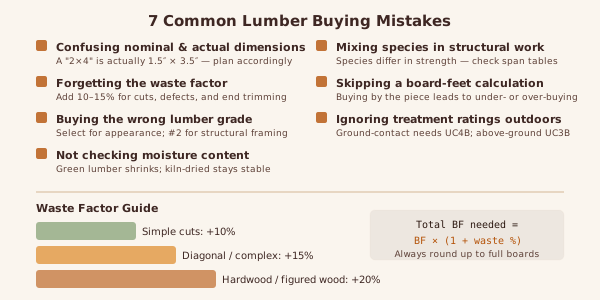
Mistake 1: Not Adding a Waste Factor
Ordering exactly the board footage your plans specify is a guaranteed second trip to the lumber yard. Real projects have waste from every cut, defective boards, miscuts, and the occasional board that's too warped to use.
Standard waste factors: 10% for simple cuts on a clean project with experienced hands; 15% for diagonal cuts, pattern work, or when you're new to the process; 20% for hardwood projects where you're selecting for grain and appearance.
For a project requiring 120 board feet, ordering 120 board feet means arriving on site with exactly zero margin. Ordering 132 board feet (10% waste) gives you roughly 12 board feet of buffer. That sounds like a lot until you encounter two warped boards, a split end you didn't notice at the yard, and a miscut on a header.
The waste factor doesn't just cover mistakes. It covers the fact that boards at a home center or lumber yard are rarely perfect. Some fraction of any stack will have excessive knots, wane, twist, or bow. Build in the margin before you order.
Mistake 2: Confusing Nominal and Actual Dimensions
This one causes calculation errors on paper before you've bought a single board. If your plan says a shelf needs to be 11.5 inches wide, you need a 1×12 (actual 0.75×11.25 inches). If you mistakenly calculate as if it's a full 12 inches wide, your shelf won't fit its space by a quarter inch, which matters when it's sitting inside a bookcase with fixed sides.
For framing, this error in the other direction: calculating joist spacing based on nominal 2×8 depth (8 inches) when the actual depth is 7.25 inches. Sub-floor calculations, ceiling height assumptions, and stair rises can all be thrown off.
The fix is simple: use actual dimensions for all layout calculations and dimensions checks. Use nominal dimensions only for ordering purposes (since that's how suppliers label their inventory). The lumber calculator lets you toggle between nominal and actual modes.
Mistake 3: Buying the Wrong Grade
Framing lumber comes in grades from Select Structural down to #3. Using #3 grade framing material for structural members (joists, rafters, headers) is a code violation and a structural risk. Using Select Structural where #2 would work wastes money.
The most common grading mistake in DIY projects: buying "utility" or "whitewood" boards from the home center bin for structural use. These are often #3 or lower grade, discounted precisely because they're not appropriate for structural framing.
Another common error: using "stud grade" lumber for horizontal applications. Stud grade is optimized for vertical loads only; it is not appropriate for joists, rafters, or headers.
For any structural application, verify the grade stamp on every board before installation. The grade stamp also shows the species, moisture content at time of grading, and grading agency. Don't rely on the bin label; check the board.
Mistake 4: Ignoring Wood Movement
Solid wood moves with changes in humidity. It expands when moisture content rises and contracts when it drops. For furniture and finish carpentry, failing to account for wood movement is the most common reason joints fail.
The most dangerous scenario: gluing up a panel across the grain without allowing for movement. A 12-inch-wide oak panel might move 1/8″ to 3/16″ seasonally. If you've glued it rigidly between stiles in a frame-and-panel door, the panel will crack the frame when it expands.
For decking, the same principle applies in reverse: install dry lumber with tight joints and it'll cup and buckle when it absorbs moisture in the first rain. Install it with 1/8″ gaps and it'll expand slightly but stay flat.
The fix: learn the expected movement for your species and application. Quarter-sawn lumber moves significantly less than flat-sawn. For furniture, always design with elongated holes or floating panels to allow movement. For decking, follow manufacturer installation guidelines for gap spacing.
Mistake 5: Not Checking for Defects at the Yard
Lumber at a home center is often stacked tightly on metal racks. Boards at the bottom of a stack may be cupped, bowed, twisted, or split, and you won't find out until you pull them out. Buying sight-unseen from the top of the pile is fine for blockage material. For anything visible or dimensionally critical, dig into the stack.
What to check: sight down the length of the board for bow (curve in the flat plane) and cup (curve across the width). Check the end grain for large checks or splits. Look for wane (missing wood at the edge from the log's outer surface). Check for excessive loose knots that will fall out during cutting.
A knot in the middle of a board isn't necessarily a problem for framing. A loose knot at a critical location in a joist can be. Select boards actively, especially for visible finish work and hardwood projects.
Mistake 6: Wrong Species for the Application
Using untreated pine for outdoor projects is the most expensive species mistake you can make (not at purchase, but at replacement). Standard construction pine will start deteriorating in 1–3 years in direct weather exposure or ground proximity. You'll spend more on the replacement than you saved on the original material.
For outdoor structural framing: pressure-treated pine (specify the correct treatment level for your application). For outdoor appearance lumber: Western Red Cedar or pressure-treated pine. For ground contact: UC4A or UC4B pressure-treated.
The reverse mistake exists too: over-specifying premium species for hidden work. Using figured walnut for cabinet carcasses that will be painted is throwing money away. Use poplar, pine, or maple for painted cabinetry. Save walnut and cherry for surfaces where the wood color and figure are visible.
Mistake 7: Ordering All at Once Without a Cut List
This sounds like good planning but often leads to waste. Ordering all your lumber at the start of a project before you've worked out your cut list means ordering more material than you need, or ordering standard lengths when odd lengths would be more efficient.
For example: you need forty pieces at 7.25 feet each (studs in an 8-foot wall with a 2-inch plate). Ordering forty 8-foot boards wastes 9 inches per board, which is 30 linear feet of waste. Alternatively, order twenty 16-foot boards and cut them in half. You get exactly what you need with near-zero waste.
Working from a cut list lets you optimize lengths, reduce waste, and sometimes discover that your project requires a non-standard size that your supplier needs to special-order. Better to know that before the delivery truck shows up.
Run each component of your project through the lumber calculator separately. Then review the list before ordering; you may find opportunities to combine sizes or optimize lengths.
Bench · Try the calculator
Lumber Calculator
Professional lumber calculator for woodworkers, contractors, and DIY enthusiasts. Calculate board feet, linear feet, and project costs.
Open calculator →